
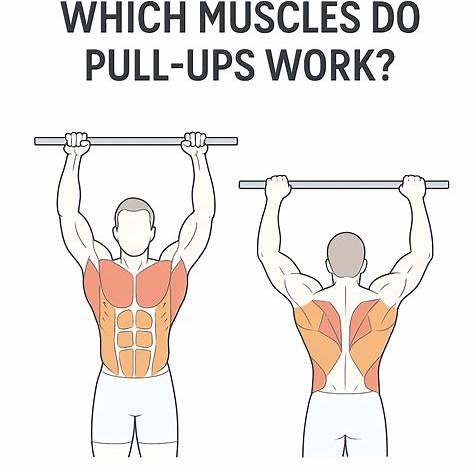
How Pull-Up Hand Positions Change Muscle Activation
Changing your hand position can alter pull-up mechanics, joint position, comfort, and the contribution of certain upper-body muscles. However, the differences in muscle activation may be smaller than commonly assumed. A peer-reviewed electromyographic study comparing pronated, supinated, neutral, and rope pull-ups found broadly similar activation across several major pulling muscles, with some grip-related differences in middle trapezius activity.
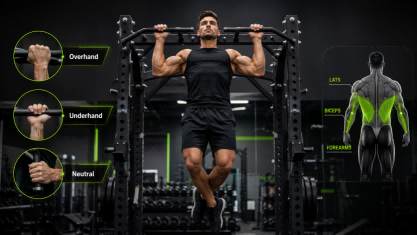
1. Standard Pull-Up with an Overhand Grip
Hand Position: Place your hands approximately shoulder-width apart with your palms facing away from your body.
Primary Muscle Worked:
Latissimus dorsi
Secondary Muscles Worked:
Biceps brachii, brachialis, brachioradialis, trapezius, rhomboids, teres major, infraspinatus, rear deltoids, and forearms
The standard overhand pull-up is one of the most effective exercises for building back strength and upper-body pulling power. This grip places strong emphasis on the latissimus dorsi, helping develop a wider and stronger back.
Your biceps, upper back, shoulders, and forearms also work together to control the movement and pull your body toward the bar. For best results, keep your core engaged, pull your shoulder blades down and back, and avoid swinging or using momentum.
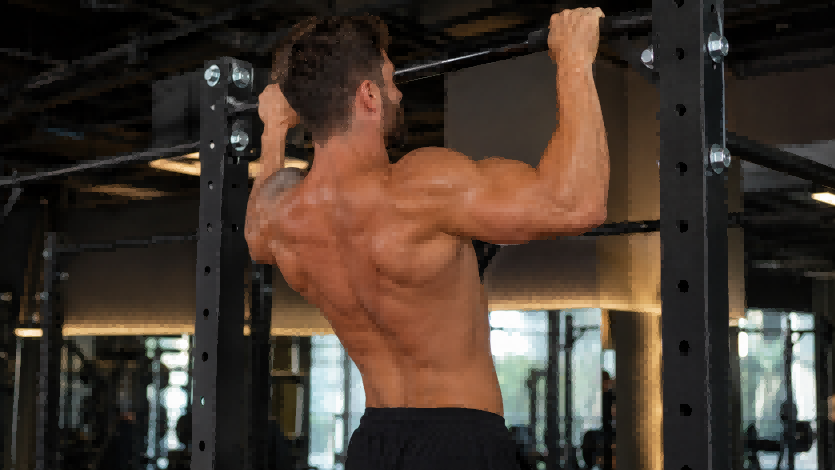
2. Chin-Up with an Underhand Grip
Hand Position: Place your hands about shoulder-width apart with your palms facing toward you.
Primary Muscle Worked:
Biceps brachii
Secondary Muscles Worked:
Latissimus dorsi, brachialis, brachioradialis, trapezius, rhomboids, pectoralis major, infraspinatus, and forearms
The chin-up uses an underhand grip that increases biceps involvement, making it one of the most effective bodyweight exercises for building arm strength and upper-body pulling power.
Although the biceps take on more of the workload, the lats and upper-back muscles remain heavily engaged throughout the movement. This makes chin-ups a valuable exercise for developing stronger arms, improving back strength, and progressing toward more advanced pull-up variations.
For proper chin-up form, keep your chest lifted, brace your core, and pull your body upward without swinging or relying on momentum.
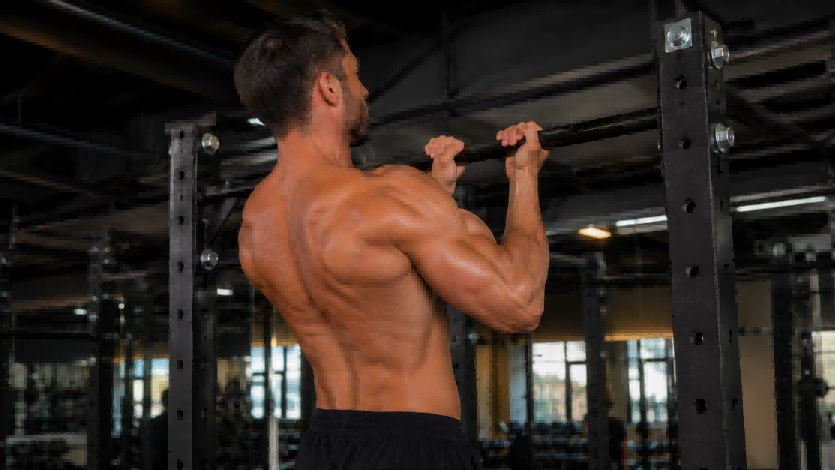
3. Wide-Grip Pull-Up
Hand Position: Place your hands wider than shoulder-width apart with your palms facing away from your body.
Primary Muscle Worked:
Latissimus dorsi
Secondary Muscles Worked:
Teres major, infraspinatus, trapezius, rhomboids, rear deltoids, biceps brachii, and forearms
The wide-grip pull-up is a challenging pull-up variation that places greater emphasis on the lats and upper-back muscles. Because the wider hand position reduces the mechanical advantage of the biceps, your back must work harder to lift and control your body.
This exercise is especially effective for building a wider back, improving upper-body pulling strength, and developing greater control through the shoulders and shoulder blades. Compared with a standard pull-up, the wide-grip version may offer a shorter range of motion but requires more strength from the back.
For proper form, keep your core braced, pull your shoulder blades down before bending your elbows, and avoid using momentum. A stable multi-grip or rack-mounted pull-up bar can provide the space and support needed for comfortable wide-grip training.

4. Close-Grip Pull-Up
Hand Position: Place your hands closer than shoulder-width apart with your palms facing away from your body.
Primary Muscles Worked:
Latissimus dorsi and lower trapezius
Secondary Muscles Worked:
Biceps brachii, brachialis, brachioradialis, rhomboids, infraspinatus, and forearms
The close-grip pull-up increases the range of motion and places strong emphasis on the lower lats and central upper-back muscles. The narrower hand position also allows the biceps and forearms to contribute more during the pulling movement.
This variation is effective for improving upper-body strength, strengthening the lower portion of the back, and developing better control through a full pull-up range of motion.
For proper form, keep your elbows close to your torso, brace your core, and pull your chest toward the bar without swinging or using momentum.

5. Neutral-Grip Pull-Up
Hand Position: Grip two parallel handles with your palms facing each other.
Primary Muscles Worked:
Latissimus dorsi, biceps brachii, brachialis, and brachioradialis
Secondary Muscles Worked:
Trapezius, rhomboids, rear deltoids, infraspinatus, forearms, and core
The neutral-grip pull-up provides balanced activation across the lats, biceps, and forearms. Because the palms face each other, the wrists, elbows, and shoulders remain in a more natural position, which many lifters find more comfortable than traditional overhand or underhand grips.
This pull-up variation is effective for building back strength, improving arm development, and increasing upper-body pulling power. It can also be a practical choice for beginners or anyone who experiences discomfort with other pull-up hand positions.
For proper form, keep your chest lifted, brace your core, and drive your elbows downward as you pull your body toward the handles. A stable multi-grip pull-up bar provides the parallel handles needed to perform this variation safely and comfortably.

6. Commando Pull-Up
Hand Position: Grip the same pull-up bar with both hands facing each other, placing one hand slightly in front of the other while your body faces sideways.
Primary Muscles Worked:
Biceps brachii, brachialis, and brachioradialis
Secondary Muscles Worked:
Latissimus dorsi, trapezius, rhomboids, rear deltoids, infraspinatus, forearms, and core
The commando pull-up combines elements of a neutral-grip pull-up with a narrow hand position. This setup increases biceps and forearm involvement while still providing an effective workout for the lats and upper-back muscles.
Because your body is positioned sideways beneath the bar, your core must work harder to resist rotation and keep the movement controlled. Alternating which side of your head passes the bar can also promote more balanced strength development.
For proper form, keep your core braced, avoid twisting your torso, and pull your shoulder toward the bar with a smooth, controlled motion. Switch your hand position between sets to train both sides evenly.
7. Archer Pull-Up
Hand Position: Use a wide grip with one arm pulling while the opposite arm remains extended toward the side.
Primary Muscles Worked:
Latissimus dorsi, biceps brachii, brachialis, and brachioradialis
Secondary Muscles Worked:
Trapezius, rhomboids, rear deltoids, infraspinatus, forearms, and core
The archer pull-up is an advanced unilateral pull-up variation that places more of your body weight on one side at a time. The working arm performs most of the pulling, while the extended arm provides limited assistance and helps control the movement.
This exercise is effective for developing side-to-side back strength, improving coordination, and identifying muscular imbalances. It is also a valuable progression for athletes working toward a one-arm pull-up.
For proper form, keep your body controlled, pull your chest toward the working hand, and avoid rotating excessively through the torso. Alternate sides evenly and master standard wide-grip pull-ups before adding archer pull-ups to your routine.
8. Angled-Grip Pull-Up
Hand Position: Place your hands on the angled handles of a multi-grip pull-up bar, allowing your wrists to remain in a more natural position.
Primary Muscles Worked:
Latissimus dorsi, biceps brachii, and brachialis
Secondary Muscles Worked:
Trapezius, rhomboids, rear deltoids, infraspinatus, brachioradialis, forearms, and core
The angled-grip pull-up combines strong lat and biceps activation with a more ergonomic hand position. The angled handles allow the wrists and elbows to follow a natural pulling path, which many lifters find more comfortable than a straight overhand grip.
This variation is effective for building back strength, improving arm development, and adding variety to an upper-body workout. It can also be a useful option for lifters who experience wrist or elbow discomfort with traditional pull-up grips.
For proper form, keep your chest lifted, brace your core, and pull your elbows down toward your sides. Avoid swinging, shrugging your shoulders, or shortening the range of motion. A stable multi-grip pull-up bar provides the handle angles needed to perform this variation comfortably and consistently.
9. Mixed-Grip Pull-Up
Hand Position: Use an overhand grip with one hand and an underhand grip with the other.
Primary Muscles Worked:
Latissimus dorsi, biceps brachii, brachialis, and brachioradialis
Secondary Muscles Worked:
Trapezius, rhomboids, rear deltoids, infraspinatus, forearms, and core
The mixed-grip pull-up combines an overhand and underhand hand position, creating a unique challenge for the back, biceps, and grip muscles. The underhand side typically receives more biceps involvement, while the overhand side places greater emphasis on the lats and upper back.
This variation can help improve grip strength, coordination, and upper-body pulling control. However, because each arm works from a different position, it may create uneven muscle loading if the same grip is used repeatedly.
For balanced development, switch your hand positions between sets and keep your torso stable throughout the movement. Avoid excessive twisting, swinging, or favoring one side as you pull toward the bar.
10. Towel Pull-Up
Hand Position: Drape two sturdy towels over a secure pull-up bar and grip one towel in each hand.
Primary Muscles Worked:
Latissimus dorsi, biceps brachii, brachialis, and brachioradialis
Secondary Muscles Worked:
Trapezius, rhomboids, rear deltoids, infraspinatus, forearms, and core
The towel pull-up is a demanding variation that places extra emphasis on grip strength and forearm endurance. Because the towels are harder to hold than a fixed bar, your hands and forearms must work continuously to maintain control throughout each repetition.
This variation still provides a strong workout for the lats, biceps, and upper back, making it an effective choice for climbers, combat athletes, and anyone looking to improve pulling strength.
For proper form, use strong towels, keep your core tight, and pull with a smooth, controlled motion. Check that the towels and pull-up bar are secure before beginning, and avoid this variation if your grip starts to fail.
11. Eccentric Pull-Up
Hand Position: Use any comfortable pull-up grip, then focus on controlling the lowering phase of the movement.
Primary Muscles Worked:
Latissimus dorsi, biceps brachii, brachialis, and brachioradialis
Secondary Muscles Worked:
Trapezius, rhomboids, rear deltoids, infraspinatus, forearms, and core
The eccentric pull-up, also known as a negative pull-up, emphasizes the lowering portion of the exercise. Start with your chin above the bar, then slowly lower your body until your arms are fully extended.
This variation helps build the strength, control, and coordination needed for a full pull-up. It is especially useful for beginners working toward their first unassisted repetition and experienced lifters trying to overcome a training plateau.
For proper form, keep your core braced and lower yourself for three to five seconds without dropping suddenly. Use a secure step or bench to reach the starting position, and stop the set once you can no longer control the descent.
Final Thoughts on Pull-Up Grip Variations
Adding different pull-up hand positions to your training routine can help you develop a stronger, more balanced upper body while keeping your workouts challenging and varied. Each grip changes how the lats, biceps, forearms, shoulders, and upper-back muscles contribute to the movement.
Choose your pull-up variations based on your goals. Wide and overhand grips can place greater emphasis on back development, while chin-ups and closer grips increase biceps involvement. Neutral and angled grips may provide a more comfortable option for the wrists, elbows, and shoulders, while towel, archer, and eccentric pull-ups can improve grip strength, unilateral control, and overall pulling performance.
You do not need to perform every variation in one workout. Start with one or two grips that match your current ability, focus on controlled technique, and gradually add more challenging movements as your strength improves.
A stable pull-up station is essential for safe and consistent training. VIGFIT offers multi-grip pull-up bars, power racks, and strength training equipment designed for home gyms, training studios, and commercial fitness facilities.
Mix up your grip, maintain proper form, and keep progressing—every controlled repetition brings you closer to a stronger back, better grip, and more powerful upper body.