
Strong, well-defined arms do more than enhance your appearance. Upper-body strength supports everyday movements such as lifting, carrying, pushing, and pulling while helping improve joint stability, posture, and overall physical performance. Whether you are new to strength training or already follow a regular fitness routine, dumbbell exercises offer a simple and effective way to strengthen your arms and develop lean muscle.
Dumbbells are versatile free weights commonly used to train the biceps, triceps, shoulders, chest, and back. The two main options are fixed and adjustable dumbbells. Fixed dumbbells are available in different weights and designs, including round and hexagonal styles, making them suitable for commercial gyms and training studios. Adjustable dumbbells combine multiple resistance levels in a compact design, making them especially convenient for home gyms and smaller workout spaces.
At VIGFIT, we understand that effective strength training depends on choosing suitable equipment and following proper exercise technique. In this guide, we introduce 15 of the best dumbbell exercises for building stronger, more defined arms. You will learn how to perform each movement correctly, which muscles it targets, and how to incorporate it into your workout routine. We will also explain the benefits of dumbbell training and share practical tips to help you exercise safely and progress consistently.
Whether you are building a home gym, upgrading a fitness studio, or developing a commercial training facility, VIGFIT provides dumbbells and strength-training equipment designed to support a wide range of users and workout goals.
Best Dumbbell Exercises for Arms
The most effective dumbbell arm workouts train the three primary areas of the arms: the biceps, triceps, and forearms. Combining exercises for each muscle group can help build balanced strength, improve muscle definition, enhance grip strength, and support better upper-body performance.
The following exercises can be performed with fixed or adjustable dumbbells and are suitable for home gyms, fitness studios, and commercial training facilities.
Dumbbell Exercises for Biceps
1. Dumbbell Bicep Curl
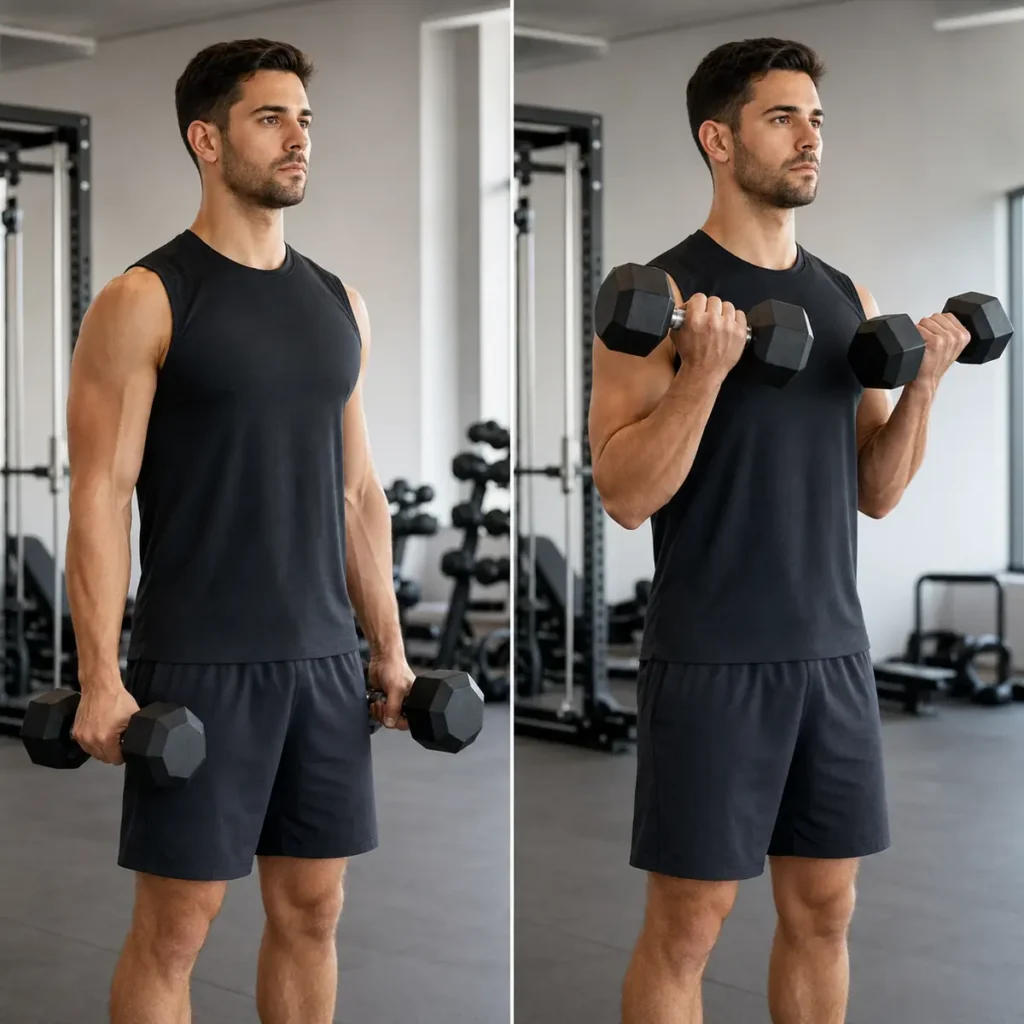
The dumbbell bicep curl is a fundamental arm exercise for strengthening and developing the biceps. It can be performed while standing or seated, making it suitable for nearly every fitness level.
How to perform it:
- Hold one dumbbell in each hand with your arms extended by your sides and palms facing forward.
- Stand upright with your feet approximately shoulder-width apart.
- Keep your chest lifted, core engaged, and elbows close to your torso.
- Exhale as you bend your elbows and curl the dumbbells toward your shoulders.
- Squeeze your biceps briefly at the top without allowing your elbows to move forward.
- Inhale as you slowly lower the dumbbells to the starting position.
- Complete 10–15 controlled repetitions.
Muscles worked:
- Biceps brachii
- Brachialis
- Brachioradialis
- Forearm muscles
2. Dumbbell Hammer Curl

The dumbbell hammer curl is an effective bicep curl variation that uses a neutral grip. In addition to developing the biceps, it places greater emphasis on the brachialis and brachioradialis, helping improve overall arm thickness and grip strength.
How to perform it:
- Hold one dumbbell in each hand with your arms extended by your sides.
- Keep your palms facing your thighs throughout the exercise.
- Stand upright with your chest lifted, core engaged, and elbows close to your torso.
- Exhale as you bend your elbows and curl the dumbbells toward your shoulders.
- Pause briefly at the top and contract your arm muscles.
- Inhale as you lower the dumbbells slowly to the starting position.
- Complete 10–15 controlled repetitions.
Muscles worked:
- Brachialis
- Brachioradialis
- Biceps brachii
- Forearm muscles
3. Incline Dumbbell Curl
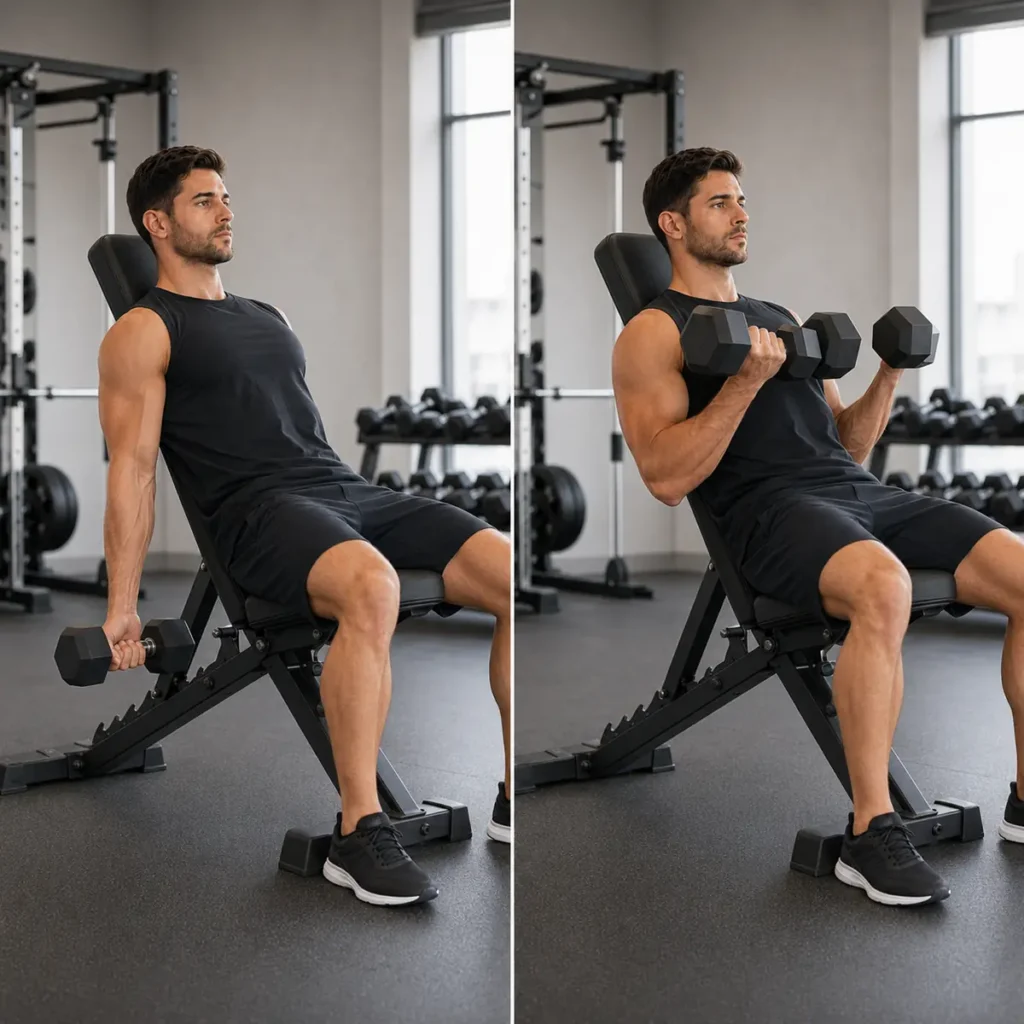
The incline dumbbell curl is a seated biceps exercise performed with the arms positioned slightly behind the torso. This position places the biceps under a greater stretch at the bottom of the movement and particularly emphasizes the long head of the biceps brachii.
How to perform it:
- Adjust an incline bench to approximately 45–60 degrees.
- Sit with your back and head supported firmly against the bench.
- Hold one dumbbell in each hand and allow your arms to hang naturally at your sides.
- Turn your palms forward, engage your core, and keep your shoulders pulled gently back.
- Exhale as you bend your elbows and curl the dumbbells toward your shoulders.
- Keep your upper arms stationary and avoid allowing your elbows to move forward.
- Pause briefly at the top before slowly lowering the dumbbells until your arms are nearly straight.
- Complete 10–15 controlled repetitions.
Muscles worked:
- Biceps brachii
- Long head of the biceps
- Brachialis
- Brachioradialis
4. Dumbbell Spider Curl
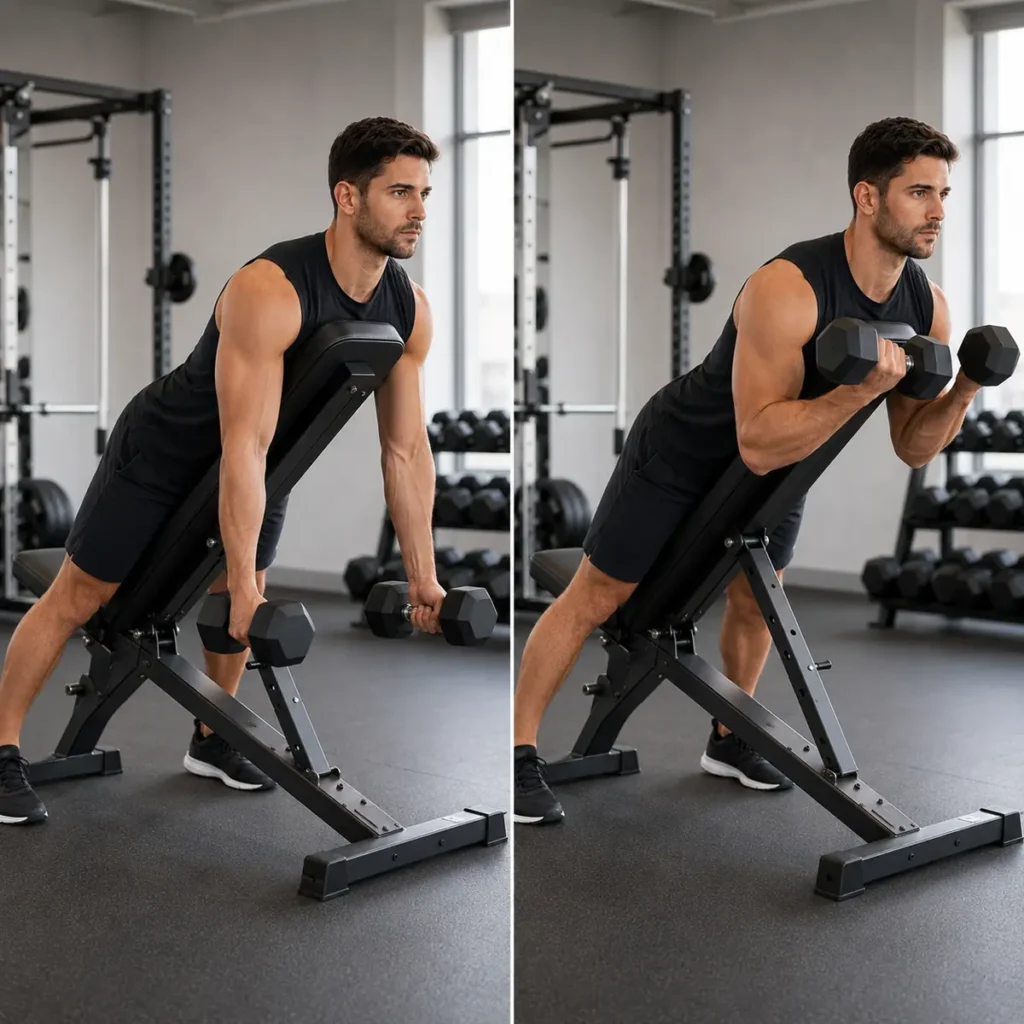
The dumbbell spider curl is a chest-supported biceps exercise performed face down on an incline bench. This position reduces assistance from the torso and shoulders, allowing you to isolate the biceps and create a strong contraction at the top of each repetition.
How to perform it:
- Adjust an incline bench to approximately 45 degrees.
- Lie face down with your chest firmly supported against the bench.
- Plant your feet securely on the floor for stability.
- Hold one dumbbell in each hand and allow your arms to hang naturally below your shoulders.
- Turn your palms forward and keep your shoulders relaxed.
- Exhale as you bend your elbows and curl the dumbbells toward your shoulders.
- Keep your upper arms stationary and avoid lifting your chest away from the bench.
- Pause briefly and contract your biceps at the top.
- Inhale as you slowly lower the dumbbells until your arms are nearly straight.
- Complete 10–15 controlled repetitions.
Muscles worked:
- Biceps brachii
- Short head of the biceps
- Brachialis
- Brachioradialis
- Forearm muscles
5. One-Arm Dumbbell Curl Over an Incline Bench
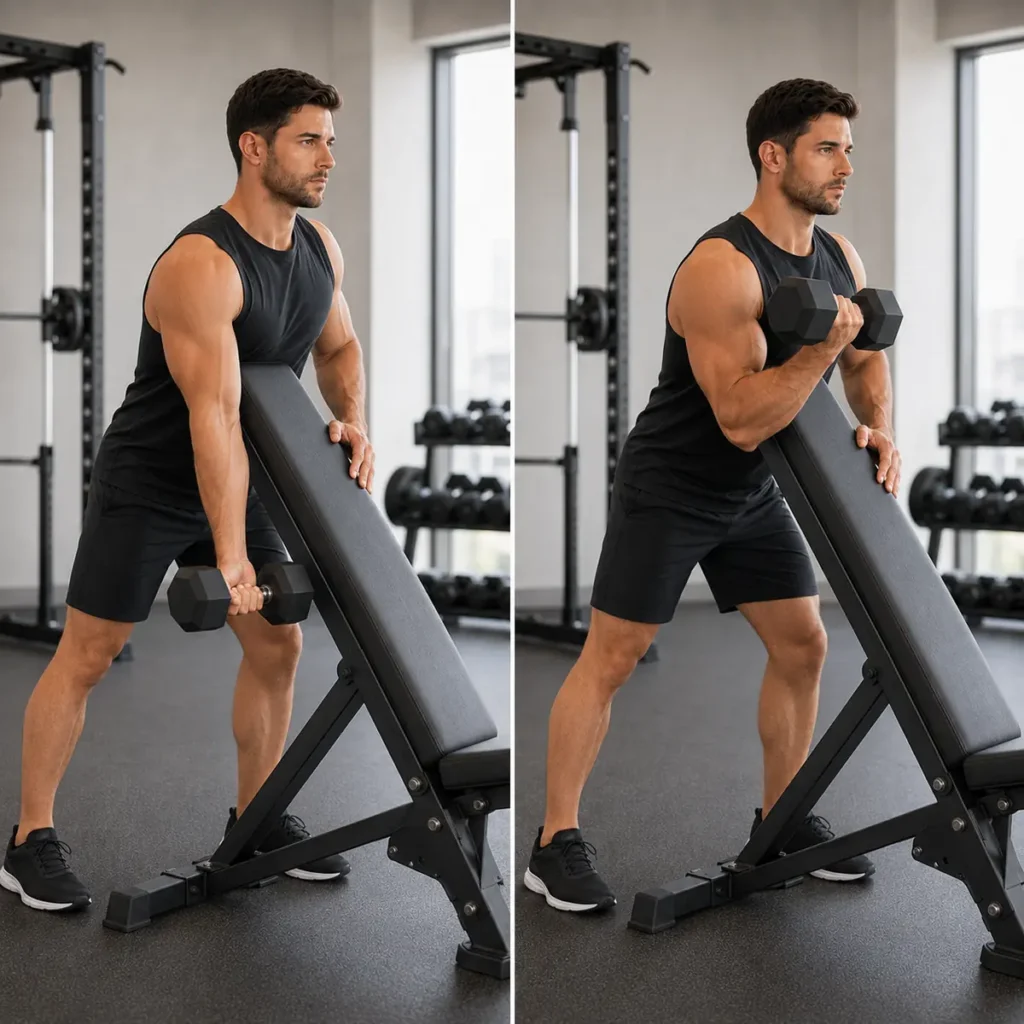
Also known as a single-arm dumbbell preacher curl, this exercise supports the upper arm against an incline bench to reduce momentum and isolate the biceps. Training one arm at a time can also help identify and address strength differences between sides.
How to perform it:
- Adjust an incline bench to approximately 45–60 degrees.
- Stand behind the bench with your feet about shoulder-width apart.
- Hold a dumbbell in one hand and place the back of your upper arm firmly against the bench pad.
- Position your armpit close to the top of the bench while keeping your shoulder relaxed and stable.
- Begin with your palm facing upward and your arm nearly extended.
- Exhale as you bend your elbow and curl the dumbbell toward your shoulder.
- Keep your upper arm in contact with the bench throughout the movement.
- Pause briefly at the top before lowering the dumbbell slowly under control.
- Complete 10–15 repetitions, then switch arms.
Muscles worked:
- Biceps brachii
- Short head of the biceps
- Brachialis
- Brachioradialis
6. Dumbbell Concentration Curl
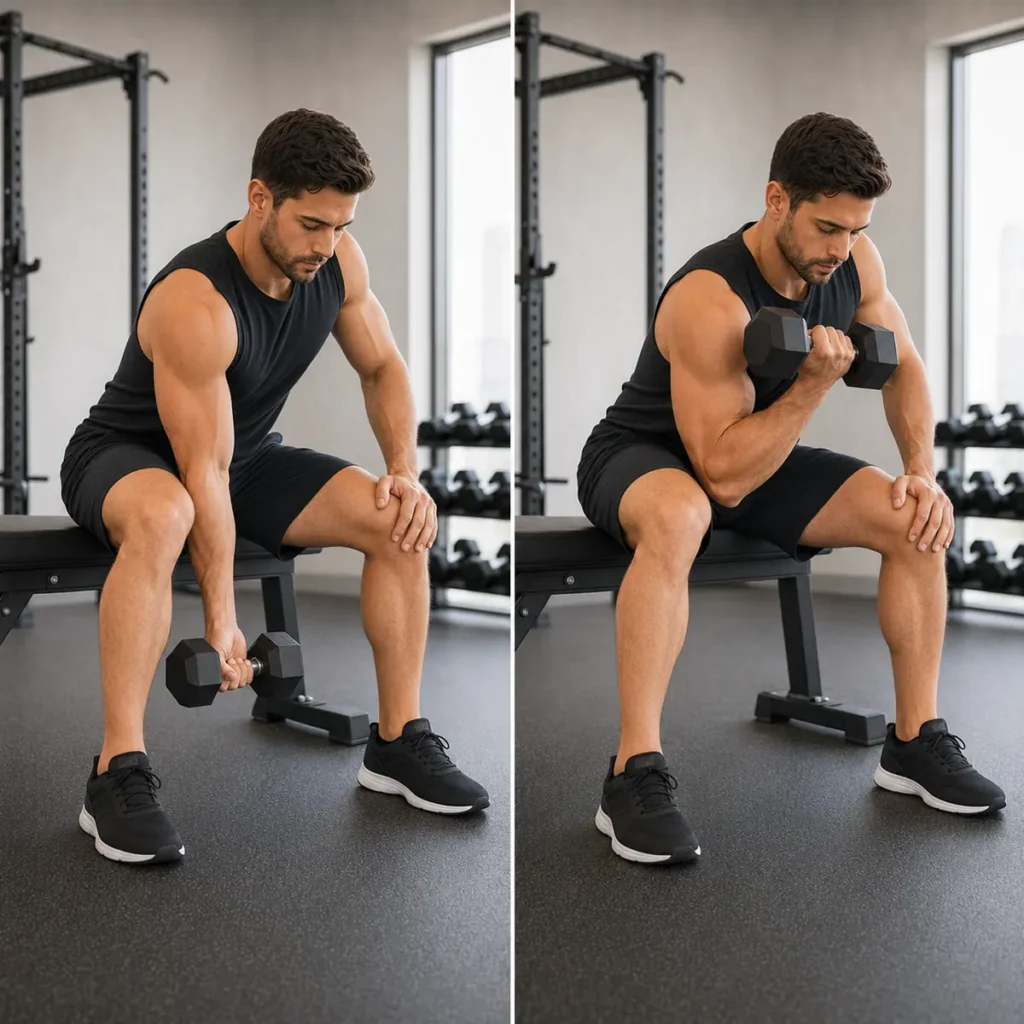
The concentration curl is a seated, single-arm exercise designed to isolate the biceps and limit assistance from the shoulders and torso. Its supported position makes it suitable for beginners and experienced lifters, provided an appropriate weight is used.
How to perform it:
- Sit near the edge of a flat bench with your feet wider than shoulder-width apart.
- Hold a dumbbell in one hand and lean forward slightly while maintaining a neutral spine.
- Place the back of your upper arm against the inside of the same-side thigh.
- Begin with your arm nearly extended and your palm facing forward.
- Keep your core engaged and your shoulder stable.
- Exhale as you bend your elbow and curl the dumbbell toward your shoulder.
- Squeeze your biceps briefly at the top of the movement.
- Inhale as you slowly lower the dumbbell until your arm is nearly straight.
- Complete 10–15 repetitions before switching sides.
Muscles worked:
- Biceps brachii
- Brachialis
- Brachioradialis
- Forearm flexors
Triceps Workouts with Dumbbells
Dumbbell triceps exercises strengthen the muscles responsible for extending the elbows and contributing to upper-arm size and pressing performance. Training all three heads of the triceps—the long, lateral, and medial heads—can support balanced arm development and improve exercises such as bench presses, push-ups, and overhead presses.
7. Overhead Dumbbell Triceps Extension
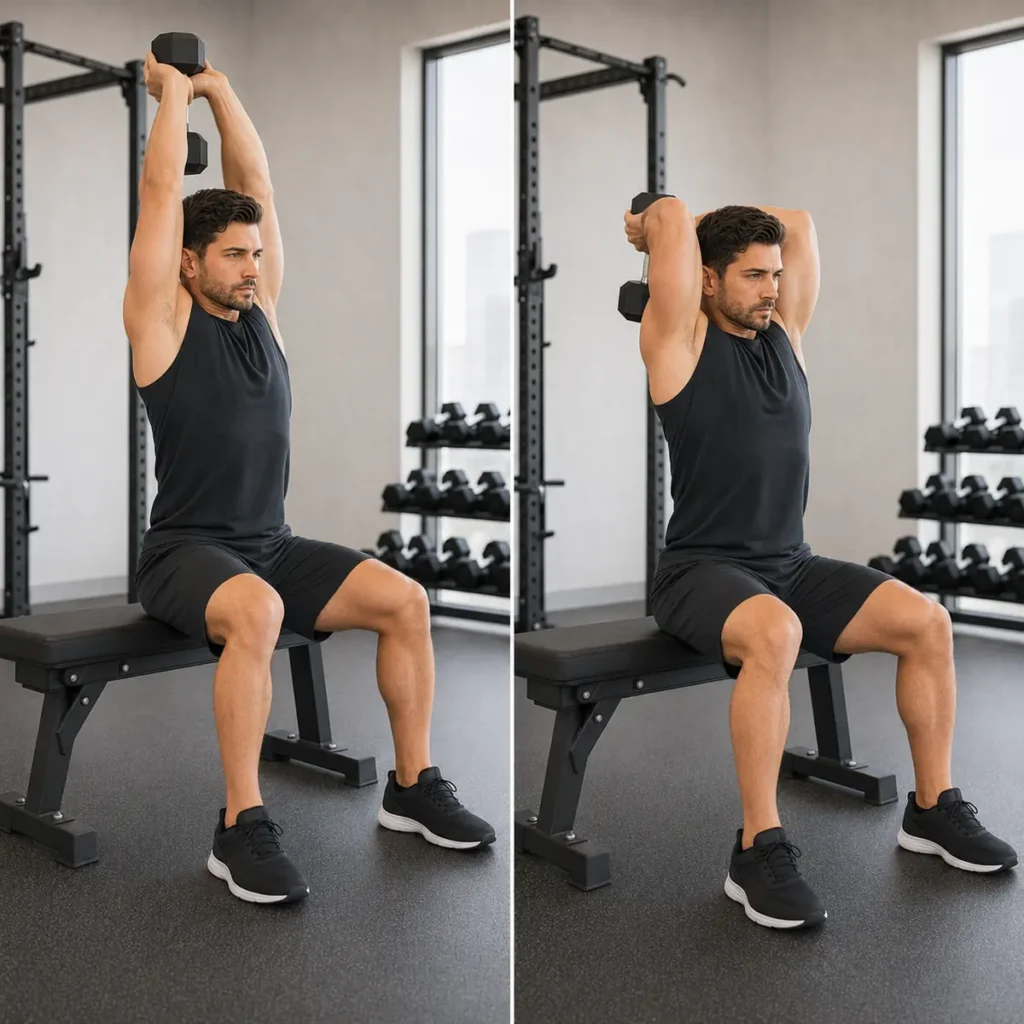
The overhead dumbbell triceps extension is a single-dumbbell exercise that places particular emphasis on the long head of the triceps. It can be performed seated or standing, depending on your experience and stability.
How to perform it:
- Sit upright on a bench or stand with your feet approximately shoulder-width apart.
- Hold one end of a dumbbell securely with both hands.
- Brace your core and extend the dumbbell directly overhead.
- Keep your upper arms close to your head and point your elbows forward.
- Inhale as you bend your elbows and slowly lower the dumbbell behind your head.
- Lower it only as far as your shoulder and elbow mobility comfortably allow.
- Exhale as you extend your elbows and raise the dumbbell back overhead.
- Keep your torso and upper arms stable throughout the exercise.
- Complete 10–15 controlled repetitions.
Muscles worked:
- Long head of the triceps
- Lateral head of the triceps
- Medial head of the triceps
- Core and shoulder stabilizers
8. Dumbbell Skull Crusher
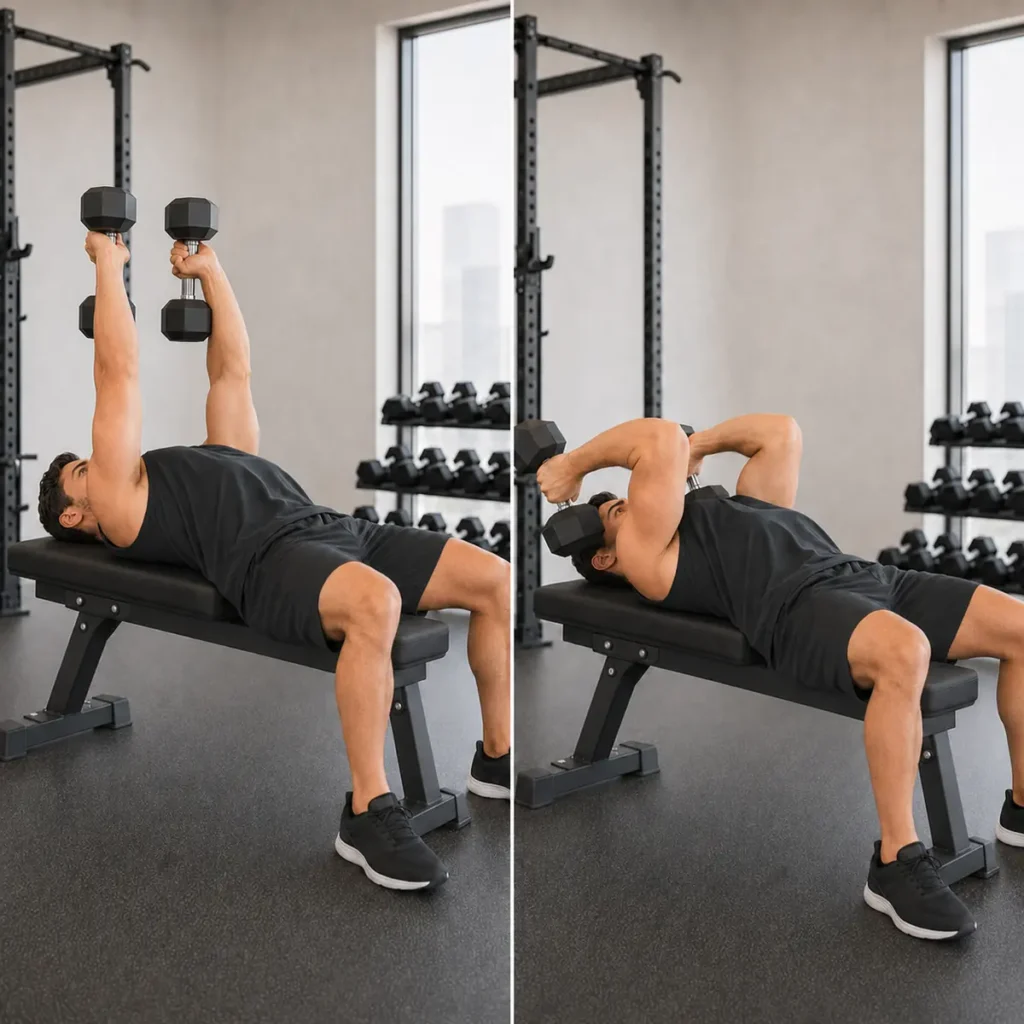
The dumbbell skull crusher, also known as a lying dumbbell triceps extension, isolates the triceps through controlled elbow flexion and extension. Strengthening the triceps can improve pressing movements such as push-ups, bench presses, and overhead presses.
How to perform it:
- Lie on a flat bench with your feet firmly planted on the floor.
- Hold one dumbbell in each hand using a neutral grip, with your palms facing each other.
- Extend your arms above your chest without forcefully locking your elbows.
- Keep your upper arms stable and angle them slightly toward your head.
- Inhale as you bend your elbows and slowly lower the dumbbells toward either side of your forehead or temples.
- Keep your elbows relatively close together and avoid allowing them to spread excessively.
- Exhale as you extend your elbows and return the dumbbells to the starting position.
- Complete 10–15 controlled repetitions.
Muscles worked:
- Long head of the triceps
- Lateral head of the triceps
- Medial head of the triceps
- Forearm and shoulder stabilizers
9. Dumbbell Triceps Kickback
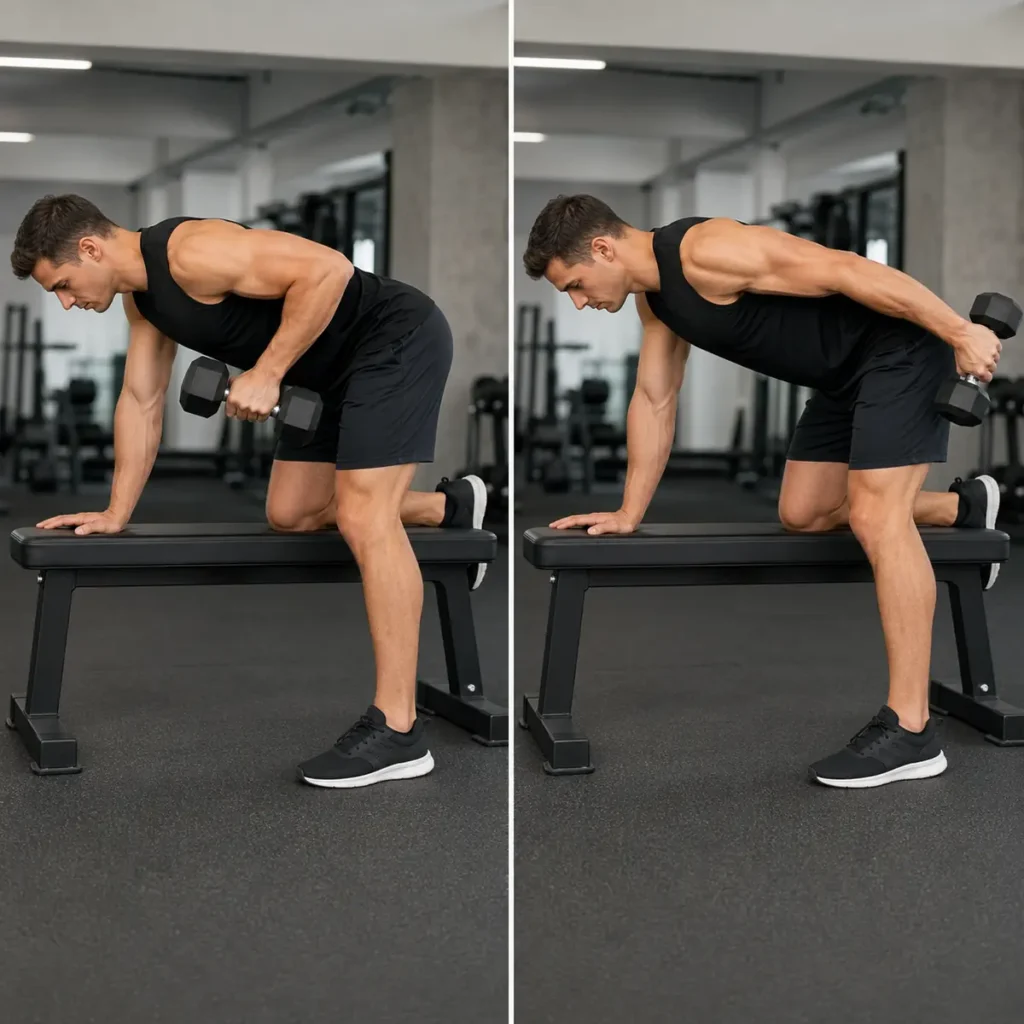
The dumbbell triceps kickback is an isolation exercise that targets all three heads of the triceps. It is most effective when performed with a light-to-moderate weight and strict control rather than momentum.
How to perform it:
- Hold one dumbbell in each hand with your palms facing inward.
- Stand with your feet approximately hip-width apart and bend your knees slightly.
- Hinge forward from your hips while maintaining a neutral spine and engaged core.
- Bend your elbows to approximately 90 degrees and keep your upper arms close to your torso.
- Exhale as you extend your elbows and move the dumbbells backward until your arms are nearly straight.
- Contract your triceps briefly without swinging your arms or lifting your shoulders.
- Inhale as you slowly return the dumbbells to the starting position.
- Complete 10–15 controlled repetitions.
Muscles worked:
- Long head of the triceps
- Lateral head of the triceps
- Medial head of the triceps
- Core and shoulder stabilizers
10. Neutral-Grip Dumbbell Bench Press

The neutral-grip dumbbell bench press is a compound upper-body exercise that trains the triceps, chest, and front shoulders. Keeping the palms facing each other and the elbows closer to the torso can increase triceps involvement while providing a comfortable pressing position for many lifters.
How to perform it:
- Sit on a flat bench with one dumbbell resting on each thigh.
- Lie back carefully and bring the dumbbells above your chest.
- Hold the dumbbells with your palms facing each other and the weights parallel.
- Plant your feet firmly on the floor, retract your shoulder blades, and brace your core.
- Inhale as you lower the dumbbells toward the sides of your chest.
- Keep your elbows approximately 30–45 degrees from your torso rather than flaring them outward.
- Exhale as you press the dumbbells upward until your arms are extended.
- Avoid forcefully locking your elbows or allowing the dumbbells to collide at the top.
- Complete 8–12 controlled repetitions.
Muscles worked:
- Triceps brachii
- Pectoralis major
- Anterior deltoids
- Shoulder and core stabilizers
Dumbbell Exercises for Forearms
Dedicated forearm exercises can complement compound pulling and curling movements by improving grip strength, wrist control, and overall arm development. Use light-to-moderate dumbbells and controlled movements, as the wrist and forearm muscles can fatigue quickly.
11. Zottman Curl
The Zottman curl combines a traditional supinated bicep curl with a pronated lowering phase. The upward portion emphasizes the biceps, while rotating the palms downward before lowering increases the involvement of the brachioradialis and forearm extensors.
How to perform it:
- Stand upright with your feet approximately shoulder-width apart.
- Hold one dumbbell in each hand with your arms extended by your sides and palms facing forward.
- Keep your core engaged, shoulders relaxed, and elbows close to your torso.
- Exhale as you curl the dumbbells toward your shoulders with your palms facing upward.
- At the top, rotate your forearms until your palms face forward and downward.
- Slowly lower the dumbbells while maintaining the overhand grip.
- At the bottom, rotate your palms forward to return to the starting position.
- Complete 10–15 controlled repetitions.
12. Dumbbell Wrist Rotations
Dumbbell wrist rotations train forearm pronation and supination—the movements that turn the palms downward and upward. This exercise can improve forearm control, wrist stability, and grip performance when performed with a light weight.
How to perform it:
- Stand or sit upright while holding one light dumbbell in each hand.
- Bend your elbows to approximately 90 degrees and keep them close to your sides.
- Position your forearms parallel to the floor with your palms facing downward.
- Keep your wrists straight and your upper arms stationary.
- Slowly rotate your forearms until your palms face upward.
- Pause briefly before rotating back until your palms face downward.
- Move only through a comfortable, controlled range.
- Complete 10–15 repetitions in each direction.
Muscles worked:
- Forearm pronators
- Forearm supinators
- Brachioradialis
- Wrist and grip stabilizers
13. Hex Dumbbell Hold
The hex dumbbell hold is an isometric grip exercise that strengthens the fingers, hands, and forearms. Instead of holding the handle, you pinch the head of each hex dumbbell, making the exercise particularly effective for developing pinch-grip strength.
How to perform it:
- Place two hex dumbbells upright on the floor beside your feet.
- Stand with your feet approximately hip-width apart.
- Hinge at your hips and bend your knees while maintaining a neutral spine.
- Grip the top head of each dumbbell with your fingers on one side and your thumb on the opposite side.
- Ensure both dumbbells are secure before lifting them.
- Drive through your feet and stand upright while keeping your arms extended by your sides.
- Keep your chest lifted, shoulders stable, and core engaged.
- Hold the dumbbells for 15–30 seconds or for as long as you can maintain a secure grip.
- Lower them slowly to the floor using a controlled hip hinge.
Muscles worked:
- Finger and thumb flexors
- Forearm flexors
- Wrist stabilizers
- Brachioradialis
- Core and shoulder stabilizers
14. Dumbbell Wrist Curl
The dumbbell wrist curl isolates the forearm flexors, which contribute to wrist movement and grip strength. It is performed with the forearms supported so that the wrists can move independently without assistance from the upper arms.
How to perform it:
- Sit on a bench with your feet firmly planted on the floor.
- Hold one dumbbell in each hand with your palms facing upward.
- Lean forward slightly and rest your forearms on your thighs.
- Position your wrists just beyond your knees so your hands can move freely.
- Keep your forearms firmly supported and your wrists aligned.
- Slowly lower the dumbbells toward the floor by extending your wrists.
- Exhale as you curl the dumbbells upward by flexing your wrists.
- Pause briefly at the top before returning to the starting position.
- Complete 10–15 controlled repetitions.
Muscles worked:
- Forearm flexors
- Wrist flexors
- Finger flexors
- Grip muscles
15. Dumbbell Wrist Abduction
Dumbbell wrist abduction, also called wrist radial deviation, strengthens the muscles that move the wrist toward the thumb side of the forearm. This controlled isolation exercise can support wrist stability, grip strength, and forearm development.
How to perform it:
- Sit on a bench and hold a light dumbbell in one hand using a neutral, hammer-style grip.
- Rest your forearm on your thigh or a flat bench with your hand extending beyond the edge.
- Keep your palm facing inward and your wrist in a neutral starting position.
- Stabilize your forearm and keep your elbow still.
- Slowly raise the thumb side of your hand toward your forearm.
- Pause briefly before lowering the dumbbell through a comfortable range.
- Avoid bending the wrist forward or backward during the movement.
- Complete 10–15 controlled repetitions, then switch sides.
Muscles worked:
- Flexor carpi radialis
- Extensor carpi radialis longus
- Extensor carpi radialis brevis
- Wrist and grip stabilizers
Benefits of a Dumbbell Arm Workout
Adding dumbbell arm exercises to a balanced strength-training program can improve upper-body strength, muscular development, grip performance, and everyday movement. Dumbbells also allow each arm to work independently, making them useful for identifying and addressing strength differences between sides.
Increased Arm Strength
Consistent dumbbell training strengthens the biceps, triceps, forearms, and supporting shoulder muscles. Stronger arms can make everyday tasks such as carrying groceries, lifting boxes, opening containers, and moving objects easier to perform.
Greater Muscle Development and Definition
Progressive resistance training can increase lean muscle mass and improve the shape of the arms. Visible muscle definition also depends on factors such as body-fat percentage, nutrition, training consistency, and genetics.
Improved Functional Fitness
Many daily movements require the arms to push, pull, carry, grip, and stabilize objects. Dumbbell exercises develop these movement patterns and can improve your ability to complete routine physical tasks with better control and confidence.
Better Athletic Performance
Stronger biceps, triceps, forearms, and shoulders can support sports that involve throwing, catching, climbing, striking, or pushing. Arm strength also contributes to compound exercises such as pull-ups, rows, bench presses, and overhead presses.
Improved Grip Strength
Exercises such as hammer curls, Zottman curls, wrist curls, and hex dumbbell holds strengthen the hands and forearms. Better grip strength can improve performance during deadlifts, rows, pull-ups, loaded carries, and many everyday activities.
More Balanced Strength Development
Because dumbbells allow each side to move independently, they can reveal differences in strength, coordination, or range of motion between the arms. Unilateral exercises make it possible to train the weaker side without allowing the stronger arm to compensate.
Versatile Training Options
Dumbbells can be used for isolation exercises and compound movements, making them suitable for beginners and experienced lifters. Fixed dumbbells work well in commercial gyms, while adjustable dumbbells provide a compact, space-saving option for home training.
Support for Joint Stability
When exercises are performed with appropriate resistance and proper technique, dumbbell training engages the smaller stabilizing muscles around the elbows, wrists, and shoulders. This can support better movement control during upper-body training.
Tips to Remember Before Starting a Dumbbell Arm Workout
Proper technique, suitable resistance, and gradual progression are essential for making dumbbell arm exercises safe and effective. Keep the following tips in mind before beginning your workout.
Start with Lighter Dumbbells
Choose a weight that allows you to learn the movement and complete every repetition with proper control. Mayo Clinic’s weight-training guidance recommends starting with a weight you can lift comfortably for 12–15 repetitions and increasing the resistance gradually as your strength improves without sacrificing technique.
Choose a weight that allows you to learn the movement and complete the full range of motion with control. Once you can perform every repetition without swinging, compensating, or losing posture, gradually increase the resistance.
Warm Up Before Training
Prepare your shoulders, elbows, and wrists with five to ten minutes of light movement. Arm circles, shoulder rotations, light resistance-band exercises, and warm-up sets with lighter dumbbells can help prepare your muscles and joints for training.
Control Every Repetition
Lift and lower the dumbbells deliberately. Swinging your torso or relying on momentum reduces the amount of work performed by the target muscles and can place unnecessary stress on the joints. Pay particular attention to the lowering phase of each exercise.
Maintain Proper Body Position
Keep your core engaged, spine neutral, and shoulders stable. During curls and triceps extensions, avoid moving your elbows excessively unless the exercise specifically requires shoulder movement.
Keep Your Wrists Neutral
Avoid allowing your wrists to bend excessively forward, backward, or sideways while holding the dumbbells. A stable wrist position improves force transfer and reduces unnecessary strain, particularly during curls, presses, and triceps exercises.
Breathe Consistently
Avoid holding your breath during ordinary arm exercises. As a general guideline, exhale during the lifting or effort phase and inhale as you return the dumbbells to the starting position.
Progress Gradually
Increase only one training variable at a time, such as weight, repetitions, sets, or movement difficulty. Small, consistent increases are more sustainable than making large jumps in resistance before your technique is ready.
Train Both Sides Evenly
Complete the same number of repetitions on each arm during unilateral exercises. If one side is weaker, begin with that arm and allow it to determine the weight and repetition count for both sides.
Allow Time for Recovery
Avoid training the same arm muscles intensely every day. Most people benefit from allowing at least 48 hours of recovery before repeating a demanding biceps, triceps, or forearm workout.
Stop if You Feel Sharp Pain
Muscle fatigue and effort are expected, but sharp, sudden, or persistent joint pain is not. Stop the exercise and review your technique, reduce the resistance, or seek guidance from a qualified fitness or healthcare professional.
VIGFIT training tip: Quality matters more than the amount of weight lifted. Select dumbbells that match your current ability and make controlled technique the priority in every set.