
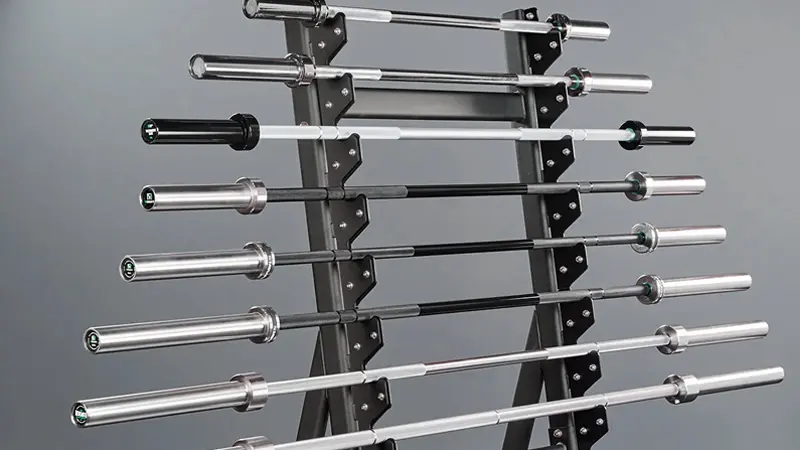
You have finally decided to take your fitness journey seriously and build your dream home gym. You have cleared out the garage, measured the floor space, laid down the rubber mats, and now it is time to buy the absolute nucleus of your training universe: the barbell.
When browsing big-box sports retailers or scrolling through Amazon, you immediately encounter the great olympic bar vs standard bar dilemma. Retailers heavily push cheap, 1-inch standard barbell kits as the ultimate “budget-friendly” starter pack. For a beginner, the financial logic seems completely sound: Why should I pay $250 to $400 for a 2-inch Olympic barbell when a 1-inch standard bar with some concrete-filled plates costs only $50? Iron is iron, right?
This is the most common—and ultimately the most expensive—mistake made in the home gym community. A 1-inch standard bar is not just a “cheaper alternative” for beginners. From a mechanical engineering and human biomechanics standpoint, it is a completely different piece of equipment that will actively hinder your progress. If you start your home gym with a standard bar, you are setting yourself up for physical injury, a rapid training plateau, and guaranteed financial waste.
To understand why professional lifters and commercial facilities refuse to use 1-inch bars, we need to dive deep into the science of lifting. Here is the hard engineering truth about why the standard bar is a liability.
Biomechanical Liability: The Fixed Sleeve Nightmare
The most glaring flaw of a standard barbell is its construction. It is manufactured as a single, continuous, solid piece of steel. The sleeves—the ends of the bar where you load the weight plates—do not spin.
Why does this matter? When you perform dynamic, multi-joint movements like a barbell bicep curl, a bent-over row, a power clean, or a snatch, the barbell travels through an arc and must change direction rapidly. If the sleeves are fixed, the rotational inertia generated by the heavy iron plates cannot be dissipated. Instead, that massive rotational force transfers immediately into your wrists, elbows, and shoulder joints.
According to sports science research by organizations like the American Council on Exercise (ACE), mitigating unnatural sheer force and rotational torque is the primary rule for preventing severe tendonitis and joint injuries. Lifting heavy weights with a standard bar is literally forcing your fragile wrist joints to fight against the brutal laws of physics.
Materials Failure: Yield Point vs. Tensile Strength
When evaluating an olympic barbell vs standard barbell, you must look at the metallurgy. Most standard bars are mass-produced using low-grade, medium-carbon iron scrap. They are not built for performance; they are built for cheap shipping.
In materials science, every piece of metal has a critical threshold known as the “Yield Point.” When you load a 1-inch standard bar with just 200 to 250 lbs and place it on your back for a heavy squat, the bar will begin to bow drastically. Because the steel quality is so poor, it quickly surpasses its yield point and undergoes plastic deformation. This means the molecular structure of the steel is compromised, and the bar will stay permanently bent. You are left trying to balance a crooked, asymmetrical piece of scrap metal on your spine, which is a recipe for a catastrophic lower-back injury.
The Ecosystem Dead-End (The Sunk Cost Trap)
Even if you don’t care about joint health or bent steel, this is the ultimate trap that catches every home gym owner. If you buy a 1-inch standard bar today, you are forced to buy 1-inch weight plates to match it.
Fast forward six months: you have gotten stronger. You decide you want to upgrade your garage gym. You want to buy a heavy-duty power rack for safer squats, a plate-loaded lat pulldown machine, or a leg press to build your quads. You start shopping online and quickly discover a harsh, undeniable reality: 99% of high-quality, modern fitness equipment is exclusively engineered to fit 2-inch Olympic plates.
Your old 1-inch plates will not fit on the 50mm storage pegs of a commercial-grade rack. Your standard bar is too short to fit across the J-hooks of a proper 7-foot cage. You have hit a dead end. You will be forced to sell your standard gear on the second-hand market at a massive loss (pennies on the dollar) and repurchase everything in the Olympic 2-inch standard. You didn’t save $200; you wasted $500.
The solution to this dilemma is unequivocal: Skip the standard bar entirely.
Standardizing your home gym with a 2-inch Olympic system from day one is the most financially sound and physically safe decision you will ever make. An Olympic bar is not a “luxury upgrade”; it is the fundamental operating system of a successful home gym.
However, buying professional gear shouldn’t require you to pay heavily inflated retail markups to overseas brands who just slap their logo on imported steel.
The VIGFIT Direct-Factory Advantage
Located in Nantong, China—the global epicenter of premium free weights and commercial gym manufacturing—VIGFIT engineers Olympic barbells that meet strict commercial tolerances. We price our equipment directly for serious home gym builders, boutique studio owners, and global wholesalers. We don’t build disposable iron; we forge generational equipment.
Here is what defines a true VIGFIT Olympic Bar, and why it is the last barbell you will ever need to buy:
- 190,000+ PSI Tensile Strength: We abandon cheap iron and forge our bars from high-alloy steel. Rated at over 190k PSI, our bars feature the perfect “whip.” They can absorb extreme loads of up to 1,500 lbs, flex dynamically during a heavy lift, and snap back to perfectly straight every single time, completely defying plastic deformation.
- Precision Independent Sleeves: Unlike the joint-destroying fixed standard bars, our 2-inch (50mm) sleeves are masterpieces of engineering. We utilize friction welding, self-lubricating brass bushings, and industrial-grade needle bearings. The sleeves spin flawlessly and endlessly, absorbing all rotational torque and keeping your wrists safe during explosive lifts.
- Aggressive, Precise Knurling: A great bar must feel glued to your hands. We use precision CNC machining to cut advanced volcano and hill knurling patterns. It provides a secure, chalk-holding grip for heavy deadlifts without tearing the calluses off your skin.
- Premium Finishes: From Hard Chrome to advanced Cerakote (ceramic-polymer coatings), our finishes prevent oxidation and rust, ensuring your bar looks pristine even in a humid, uninsulated garage gym.
🚀 Don’t let a $50 “standard” mistake ruin a $5,000 home gym setup.
Your body deserves better biomechanics, and your wallet deserves a better return on investment. Stop paying for retail logos and start investing in your gym’s structural ecosystem today.
Wholesalers & Gym Owners: Are you an equipment dealer looking for high-margin inventory, or outfitting a massive commercial facility? Contact the VIGFIT engineering team directly for factory-direct wholesale pricing, custom OEM branding (put your logo on our steel!), and flexible global shipping options!