
Choosing commercial gym equipment is not simply a matter of filling a room with popular machines. It is a business decision that affects member experience, floor capacity, staffing, maintenance costs, safety and the long-term profitability of your facility.
Many buyers begin with product catalogs and prices. They compare treadmills, racks and strength machines before defining who will use the facility, how people will train and how the space needs to operate during peak hours. This often leads to crowded layouts, underused machines and unexpected costs after opening.
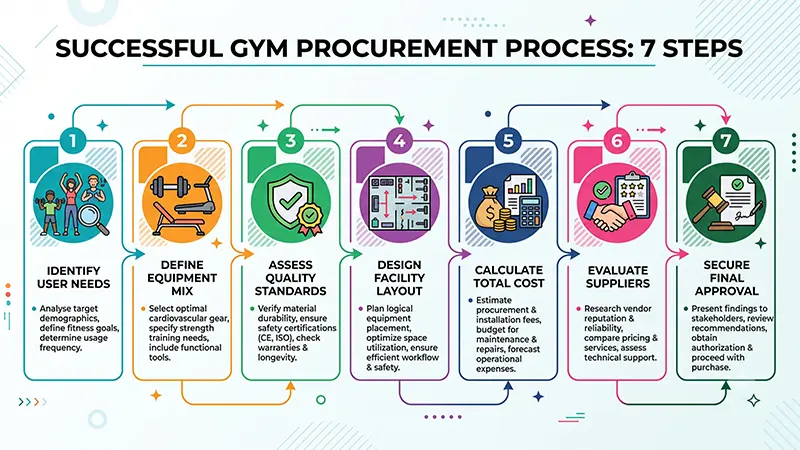
A better approach is to make the decisions in sequence: define the facility and its users, build the right equipment mix, verify commercial-grade quality, test the proposed layout, calculate total ownership cost and then evaluate the supplier’s delivery and after-sales capabilities.
This guide explains how to choose commercial gym equipment using that process.
Quick Answer: A Seven-Step Selection Framework
To choose commercial gym equipment effectively :
- Define the facility type, target users and peak-hour demand.
- Create an equipment mix based on training demand rather than catalog variety.
- Confirm whether each model is suitable for full commercial use.
- Review safety, construction, adjustability, serviceability and supporting documents.
- Complete the layout before placing the order.
- Compare total ownership cost instead of purchase price alone.
- Evaluate quality control, warranty, spare parts and after-sales support.
Following these steps helps prevent an equipment order from becoming a collection of isolated products. The result should be a coordinated training environment that supports your members, operators and business model.
1. Define the Facility Before Selecting the Equipment
A commercial gym, a personal training studio, a hotel fitness room and a corporate wellness center should not use the same purchasing formula. Their users, traffic patterns, supervision levels and training expectations are different.
Start by documenting the following information :
- Facility type and business model
- Total usable training area
- Target users and experience levels
- Expected membership or daily user volume
- Estimated peak-hour occupancy
- Group classes, personal training or rehabilitation services
- Target opening date and future expansion plan
For example, a general membership gym usually requires broad coverage across cardio, strength, free-weight and functional zones. A boutique strength studio may need fewer equipment categories but greater capacity around racks, benches and lifting platforms. A hotel gym often needs intuitive equipment, quiet operation and a compact layout suitable for unsupervised users.
Do not allocate the budget according to an arbitrary equipment ratio found online. Use expected user behavior, training programs and peak-hour demand. If several members are likely to need the same exercise station at the same time, capacity and duplication may be more valuable than adding another rarely used machine.
| Facility type | Primary priorities |
| Full-service commercial gym | Broad equipment coverage, peak-hour capacity, durability, maintenance access |
| Personal training studio | Coaching workflow, versatile stations, open floor area |
| Hotel or residential gym | Ease of use, low noise, compact footprint, clear instructions |
| Corporate fitness center | Ease of use, low noise, compact footprint, clear instructions |
| Strength or performance facility | Accessibility, mixed fitness levels, efficient use of space |
| Functional training studio | Open space, modular storage, rigs and portable accessories |
2. Build the Equipment Mix Around User Demand
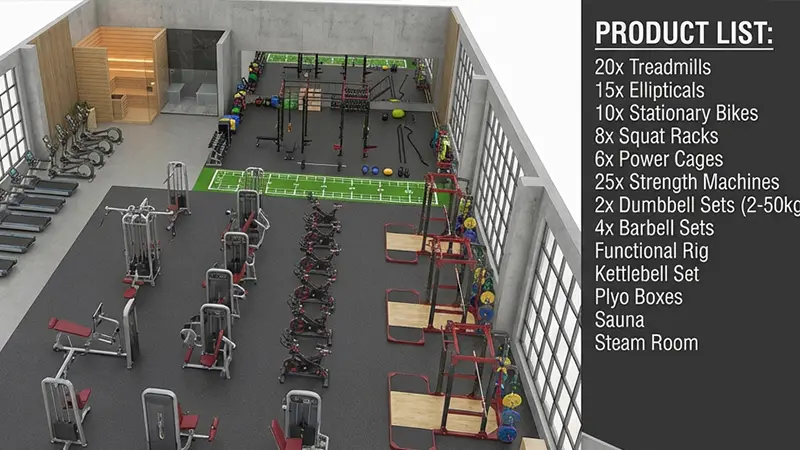
A commercial gym equipment list should be the result of a planning process, not the starting point. First determine the training zones your users need, and then select the appropriate products for each zone.
A typical facility may include the following equipment groups :
- Cardio equipment: treadmills, exercise bikes, ellipticals, rowing machines and stair climbers
- Selectorized strength equipment: machines with integrated weight stacks and guided movement paths
- Plate-loaded equipment: strength machines loaded with Olympic weight plates
- Free-weight equipment: racks, benches, barbells, dumbbells and lifting platforms
- Functional training equipment: rigs, cable stations, sleds, kettlebells, medicine balls and resistance tools
- Mobility and recovery equipment: mats, stretching areas, rollers and recovery accessories
- Storage and safety accessories: plate trees, dumbbell racks, barbell storage and floor protection
Begin by separating products into three groups: essential for opening, useful when the budget permits and suitable for a later expansion phase. This prevents attractive but low-priority products from consuming space needed by high-demand stations.
Multi-function machines can improve space efficiency, especially in hotels, studios and smaller facilities. However, buyers should also examine how many people can use the unit simultaneously, whether adjustments slow down member turnover and whether one technical failure could remove several exercise functions at once.
High-demand movements may need deliberate redundancy. Two frequently used benches or cable stations can provide more operational value than two specialized machines that members rarely use.
Relevant VIGFIT product categories :
3. Verify What “Commercial Grade” Actually Means
“Commercial grade” should describe the equipment’s intended operating environment and verified performance—not function only as a marketing label.
A product designed for a lightly used apartment gym may not be appropriate for a membership facility operating for long hours with repeated daily use. Buyers should ask the supplier to define the intended use class, operating conditions, user limitations and maintenance requirements for each model.
What to Inspect:
Frame, stability and joints: Review frame construction, base stability, weld consistency, bolted connections and anchoring requirements. Steel thickness alone does not determine the quality of a complete machine.
Movement path and adjustability: The machine should support a controlled movement path and accommodate the expected range of user sizes. Check seat adjustment, starting position, handle reach and ease of entry and exit.
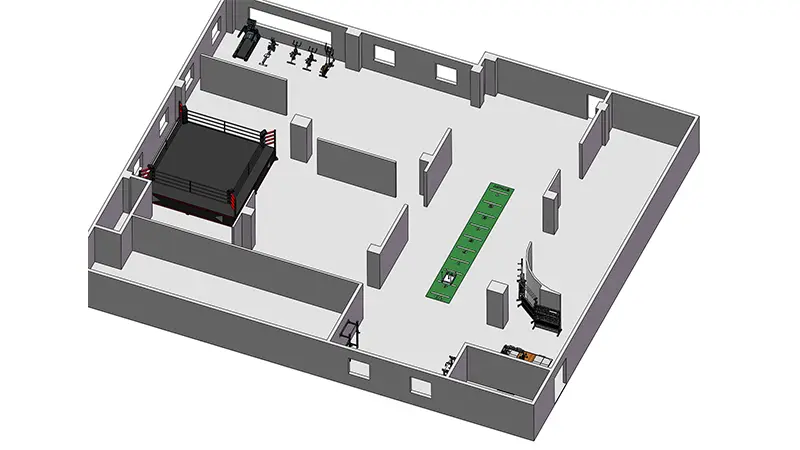
Wear components: Examine cables, pulleys, bearings, guide rods, pop pins, belts, upholstery and protective covers. Ask how these parts are inspected and replaced.
Cardio systems: For treadmills and other powered equipment, review the drive system, deck and belt, electronics, ventilation, power requirements, operating environment and service access.
Identification and documentation: Each model should have clear identification, instructions, maintenance information and a way to trace relevant parts or production records.
The general international reference for stationary training equipment is ISO 20957-1:2024. Additional parts address particular equipment categories. For example, ISO 20957-2:2024 covers stationary strength training equipment, while ISO 20957-6:2021 addresses treadmills.
Do not accept a general statement such as “our equipment is certified” without checking its scope. Request the certificate or test report, the issuing or testing organization, the covered standard, the product models included and the validity information. A document for one model should not automatically be treated as evidence for an entire catalog.
Model identification and parts traceability also matter after delivery. Exercise-equipment recalls published by the U.S. Consumer Product Safety Commission demonstrate why operators need to identify affected models and obtain repairs or replacement components efficiently.
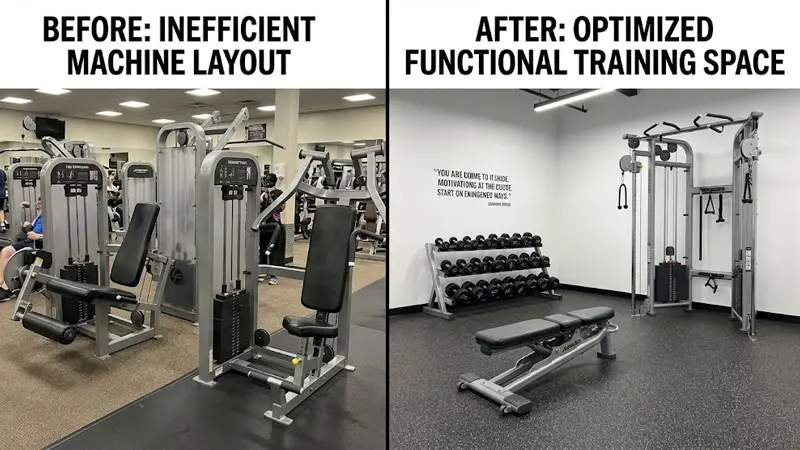
4. Complete the Layout Before Confirming the Order
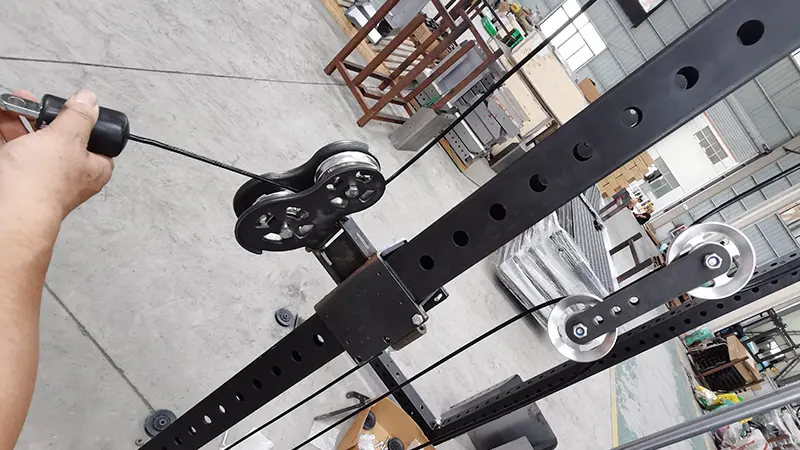
A product dimension shown in a catalog is not the same as the space required to operate that product safely.
The layout should account for :
- The physical dimensions of the equipment
- The user’s movement and exercise envelope
- Entry, exit and adjustment space
- Loading space for weight plates
- Maintenance and service access
- Circulation routes and emergency movement
- Accessible routes and transfer positions
- Storage for accessories and loose equipment
For projects in the United States, accessibility planning deserves particular attention. The U.S. Access Board explains that at least one of each type of exercise machine or equipment must be served by an accessible route and have a clear floor space of at least 30 × 48 inches. The exact project should be checked against applicable regulations and local requirements rather than relying on one general diagram.
Heavy free-weight zones may also require structural review. Do not assume that a generic floor-loading figure is suitable for every building. Equipment weight, users, storage, impact loading and placement should be reviewed with the equipment supplier and, when needed, a qualified local structural professional.
Noise and vibration are especially important for hotels, apartments and mixed-use buildings. The solution may involve equipment selection, rubber flooring, isolation layers, platform construction and changes to equipment placement.
Powered cardio equipment also requires electrical and environmental planning. Confirm outlet locations, voltage, plug type, circuit capacity, ventilation, network requirements and access for future servicing before the shipment is arranged.
A practical layout process includes a scaled two-dimensional plan, final model dimensions and a review of member and staff circulation. For critical zones, marking equipment footprints on the floor with tape can reveal conflicts that are difficult to see on a small drawing.
5. Compare Total Cost of Ownership, Not Only Purchase Price
The lowest equipment quotation is not always the lowest-cost solution.
A more useful comparison considers the total cost of ownership:
Total ownership cost = equipment price + freight and import costs + site preparation + installation + planned maintenance + expected repairs and parts + downtime cost − residual value
Compare supplier offers using the same equipment list, specification level, delivery term and service scope. Otherwise, the cheapest quotation may simply exclude costs that appear later.
6. Evaluate the Supplier as Carefully as the Equipment
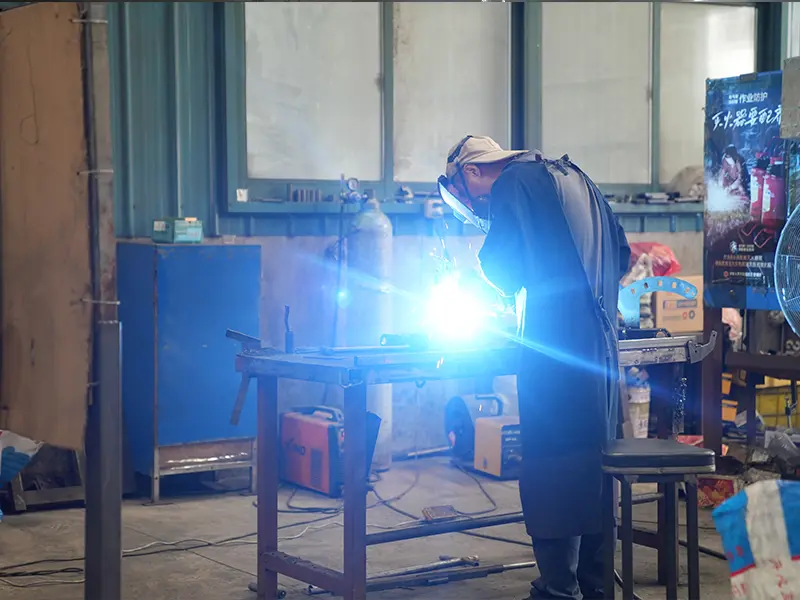
Commercial gym equipment is a long-term operational asset. The supplier’s ability to control production, document quality, provide parts and respond to technical issues can be as important as the product specification.
Use the following questions when comparing suppliers :
- Is the company the manufacturer, an exporter, a trading company or a combination of these roles?
- Which parts of production are completed internally, and which are outsourced?
- Can the supplier provide the exact legal company name, factory address and contact details used in the contract?
Product Evidence
- Can it provide model-specific specifications, manuals, drawings and test documentation?
- Can you review a sample, inspection video or detailed product photographs before bulk production?
- Are requested colors, logos, upholstery and packaging recorded in an approved specification sheet?
Quality Control
- Which checks occur during incoming material inspection, production and final inspection?
- Will the buyer receive a written inspection report before shipment?
- Is third-party inspection permitted?
- How are nonconforming products corrected and documented?
Delivery and Installation
- Does the quotation define production lead time, packing method and delivery terms?
- Can different product categories be consolidated into one shipment when appropriate?
- Are assembly instructions, packing lists and installation support available?
Warranty and After-Sales
- Which components are covered, for how long and under what conditions?
- What is excluded from the warranty?
- Who pays for replacement parts, international freight and local labor?
- How are parts identified and ordered?
- What technical information is required before a warranty claim is approved?
A useful warranty document should define coverage, exclusions, buyer responsibilities and the claim procedure. A long headline warranty period has limited value if the covered parts and response process are unclear.
For suitable projects, VIGFIT can combine equipment selection with layout and customization discussions. Mixed-product loading may help buyers consolidate different equipment categories in one shipment, while pre-shipment inspection records can give the buyer a documented review point before cargo release. The exact scope should be confirmed in the quotation and purchase agreement for each project.
Learn more about VIGFIT or discuss a project through the contact page.
Common Commercial Gym Equipment Buying Mistakes
- Starting With a Product Catalog
- Buying Too Much Variety
- Choosing by Headline Specifications Alone
- Ignoring Operating and Service Space
- Comparing Only the Quoted Price
- Accepting a Vague Warranty
- Ordering Without Change Control
Conclusion
The right commercial gym equipment package begins with the facility—not the product catalog. When the user profile, training demand and space are clearly defined, the equipment list becomes easier to evaluate.
The strongest purchasing decisions balance equipment variety with capacity, commercial durability with maintainability, and purchase price with long-term operating cost. Layout, documentation, quality control, spare parts and after-sales support should all be reviewed before the order is finalized.
Treat the project as a complete operating system rather than a collection of machines. This improves the likelihood that the final gym will be practical for members, manageable for employees and sustainable for the business.
Request a Commercial Gym Equipment and Layout Proposal
Planning a new commercial gym, hotel fitness room, studio or corporate training facility?
Send VIGFIT the following project information:
- Floor plan and usable dimensions
- Facility type and target users
- Preferred training zones or equipment
- Target equipment budget
- Destination country
Based on these inputs, the equipment selection, quantity, layout and customization requirements can be discussed around the actual project rather than a generic product list.