
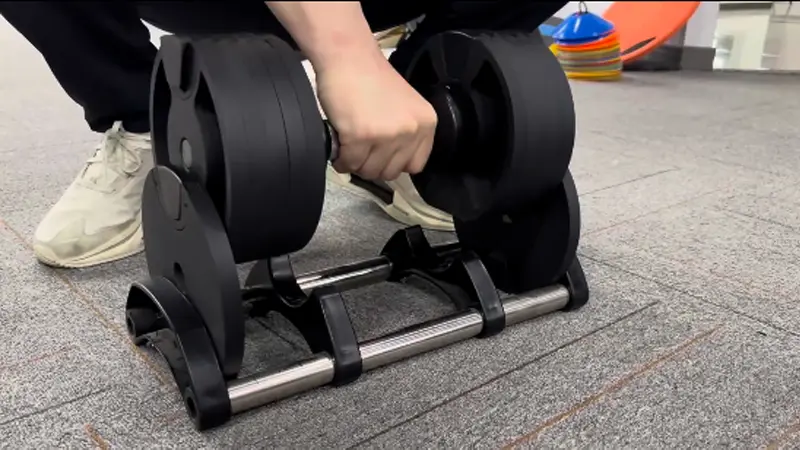
Adjustable dumbbells provide multiple weight settings in one compact system. They are widely used in home gyms, personal training studios, hotel fitness rooms and other facilities where floor space matters.
However, not every adjustable dumbbell set offers the same training experience or durability. Weight range is important, but buyers should also evaluate the adjustment mechanism, weight increments, handle shape, plate security, storage system and intended usage environment.
This guide explains how adjustable dumbbells work and what to check before choosing a set.
What Are Adjustable Dumbbells?
Adjustable dumbbells allow users to increase or decrease resistance without storing a separate pair for every weight. Depending on the design, weight may be changed through removable plates, a selector pin, a rotary dial or a handle-operated mechanism.
Their main advantage is consolidation. One adjustable dumbbell set can cover multiple exercises and strength levels while occupying much less storage space than a full rack of fixed dumbbells.
Main Benefits of Adjustable Dumbbells
- Space efficiency: Adjustable dumbbells are especially useful in apartments, home gyms, hotel fitness rooms and compact studios where a complete fixed-weight rack would occupy too much floor area.
- Training flexibility: Users can select lighter resistance for raises and arm exercises, then change to heavier resistance for presses, rows or lower-body movements.
- Simplified storage: A tray or adjustable dumbbell stand keeps the weights organized and can reduce clutter around the training area.
The trade-off is mechanical complexity. Unlike a solid fixed dumbbell, an adjustable model contains moving or removable components that require correct operation, inspection and maintenance.
Types of Adjustable Dumbbells
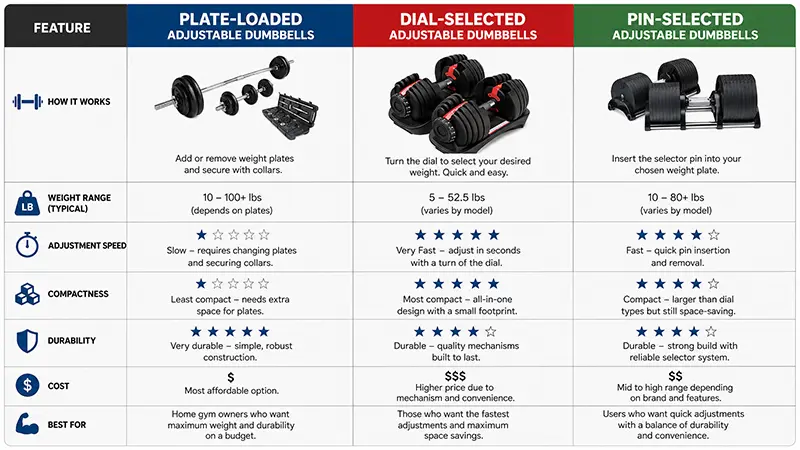
Plate-Loaded or Spin-Lock Dumbbells
These use separate weight plates secured by threaded collars. They are normally simple and flexible, but changing the weight takes longer and loose plates require additional storage.
Dial or Handle-Selected Dumbbells
The dumbbell sits in a tray while the user selects a weight by turning a dial or handle. These systems support fast changes between exercises, but their internal locking components should be protected from impact and incorrect adjustment.
Pin-Selected or Block-Style Dumbbells
A selector pin determines which weight sections are lifted with the handle. This design can be compact and easy to adjust, although its shape feels different from a traditional round dumbbell.
How to Choose Adjustable Dumbbells
1. Match the Weight Range to the Exercises
Consider both the starting weight and maximum weight. Beginners and rehabilitation users may need a low starting resistance, while experienced lifters may require heavier settings for presses, rows, squats or Romanian deadlifts.
Do not choose only for current strength. The range should leave room for progression without forcing the buyer to replace the set too soon.
2. Check the Weight Increments
Smaller increments support gradual progression and are useful for exercises involving smaller muscle groups. Larger jumps may be acceptable for heavy compound exercises but can be inconvenient for shoulder, arm or rehabilitation training.
3. Evaluate Adjustment Speed and Simplicity
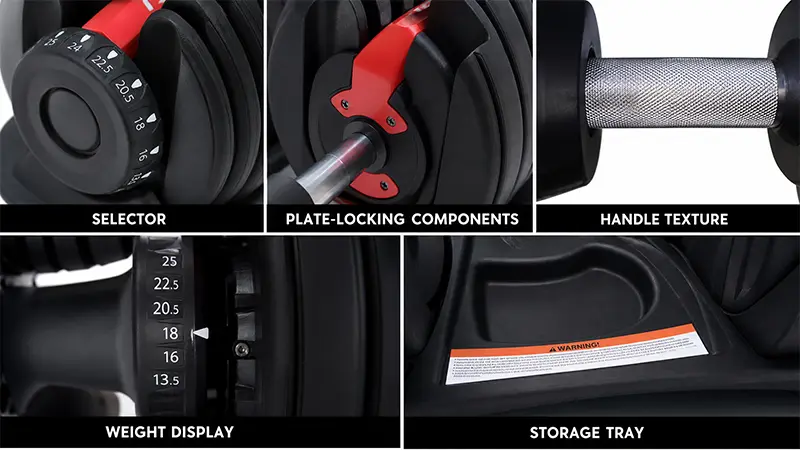
Fast adjustment is valuable for circuits, supersets and personal training sessions. The mechanism should be easy to understand, clearly indicate the selected weight and lock securely before the dumbbell leaves its tray.
4. Examine Handle Shape and Overall Length
Review grip diameter, texture, usable handle space and balance. Some adjustable dumbbells remain the same length at every setting, which may affect curls, presses or movements where the dumbbells pass close to the body.
5. Inspect the Locking and Plate-Retention System
The selected plates should remain securely connected to the handle during normal use. Buyers should inspect the selector, tray alignment and visible wear points and follow the model-specific operating instructions.
Are Adjustable Dumbbells Suitable for Commercial Gyms?
They can be suitable for personal training studios, hotel gyms and supervised training areas, but buyers should not assume that every home model is approved for commercial use. For example, PowerBlock’s warranty information distinguishes home models from products authorized for commercial environments.
Facility buyers should confirm the intended use, user frequency, inspection procedure, parts availability and commercial warranty. In a busy gym where several members need the same weight simultaneously, fixed dumbbells may still provide better capacity and faster member turnover.
Safety and Maintenance
Adjust the dumbbell only as directed by its manufacturer, normally while it is correctly seated in its tray. Check that the selection mechanism is fully engaged before lifting, and do not drop the dumbbell unless the manufacturer expressly permits a defined impact condition.
Model and serial-number traceability also matter. A 2025 U.S. CPSC recall involving specific BowFlex adjustable dumbbells concerned plates that could dislodge during use. This shows why locking reliability, product identification and after-sales response should be evaluated before purchase.
Conclusion
The right adjustable dumbbells should match the user’s strength level, exercises, available space and usage environment. Weight range may attract the most attention, but increments, adjustment speed, grip, balance, locking reliability, warranty and spare-parts support often determine long-term satisfaction.
If you are sourcing adjustable dumbbells for a fitness brand, wholesale catalog, e-commerce store, hotel gym or training studio, send VIGFIT your required weight range, adjustment type, quantity, target market, branding and packaging requirements.